

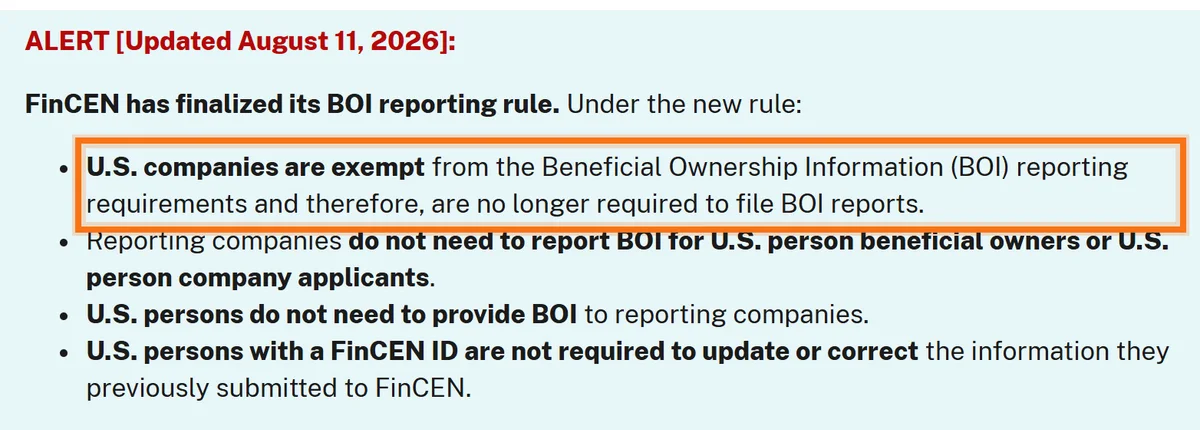
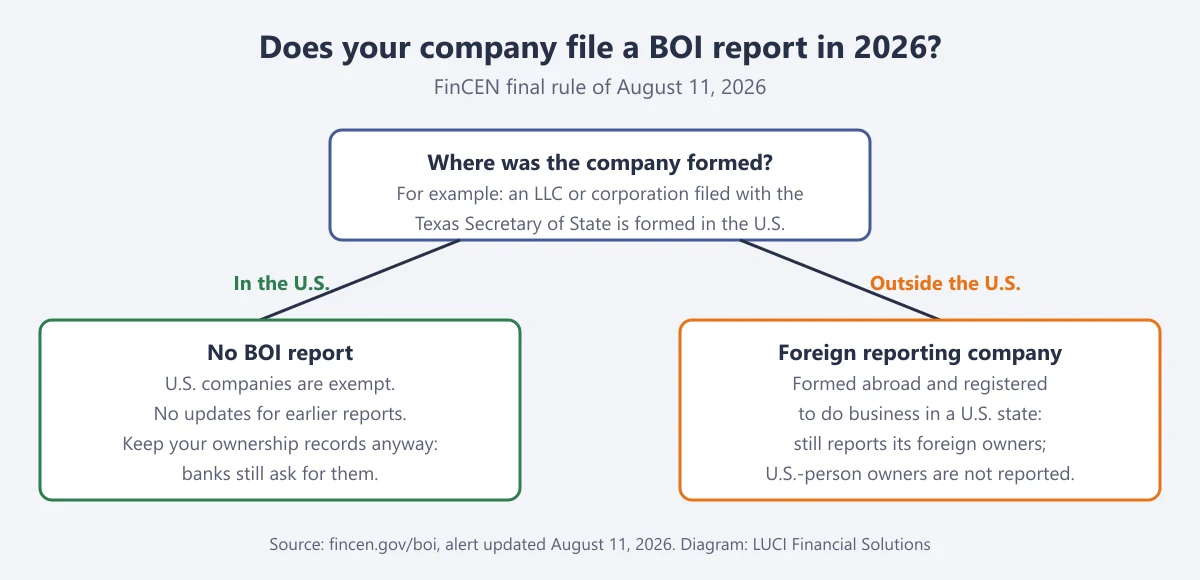
Short answer: Most Dallas business owners no longer file a beneficial ownership information (BOI) report. Under FinCEN’s final rule of August 11, 2026, companies created in the United States, including Texas LLCs and corporations, are exempt, and reports filed earlier do not need updating. Only foreign companies registered to do business in a U.S. state still report, and only their non-U.S. owners.
Key takeaways
- U.S.-formed companies, including Texas LLCs and corporations, do not file BOI reports.
- If you filed in 2024 or 2025, you do not need to update or correct that report.
- Foreign reporting companies registered in a U.S. state still report their non-U.S. owners.
- Letters demanding a BOI filing or form can be scams; go to fincen.gov/boi directly.
- Keep ownership records and your books in agreement anyway: banks, lenders and buyers still ask.
What the beneficial ownership information report was
The Corporate Transparency Act, passed in 2021, required many small companies to report their beneficial owners to the Financial Crimes Enforcement Network (FinCEN), a bureau of the U.S. Treasury. Reporting started on January 1, 2024. A beneficial owner was anyone who owned at least 25% of the company or exercised substantial control over it, such as a senior officer. Reports included each owner’s name, date of birth, address and an identifying document.
This article was first written in 2024, when nearly every LLC and corporation had to file. The rules have changed since, so the version below reflects what FinCEN publishes today.
How the BOI rules changed from 2024 to 2026
| Date | What happened | What it meant for a Dallas company |
|---|---|---|
| January 1, 2024 | BOI reporting began under the Corporate Transparency Act | Most LLCs and corporations had to file |
| December 2024 | A federal court in Texas blocked enforcement nationwide for a time; deadlines moved several times | Filing was paused and restarted while appeals went on |
| March 2025 | FinCEN interim final rule: U.S.-created entities and their owners exempted | No filing required for domestic companies |
| August 11, 2026 | FinCEN final rule: U.S. companies permanently exempt; U.S. persons need not update earlier reports | No filing and no updates; only foreign reporting companies report |
How to read this table: the last row is the rule today. If you are reading older advice, including from 2024 or early 2025, check its date against this timeline before acting on it.
Who still has to file a BOI report
Under the current rule, a reporting company is an entity formed under the law of a foreign country that has registered to do business in a U.S. state or tribal jurisdiction. For example, a company formed in Canada or Mexico that registers with the Texas Secretary of State to operate in Dallas. Such a company reports its beneficial owners who are not U.S. persons; it does not report U.S. owners or U.S. company applicants.
Under FinCEN’s March 2025 rule, foreign companies registering after that date had 30 calendar days from the effective date of their registration to file. If your company is in this group, check the current deadline and filing instructions on fincen.gov/boi, or ask your attorney or CPA, before you register.
What this means for a Dallas LLC or corporation
If your business was formed by filing a certificate of formation with the Texas Secretary of State, or formed in any other U.S. state, you do not file a BOI report and do not need a FinCEN ID. Owners who already filed do not need to update or correct their reports.
What matters is where the company was formed, not who owns it. A Texas LLC owned by a person who lives abroad, or by a foreign parent company, is still a U.S. company under the current rule and is exempt. The reverse also holds: a company formed in another country stays a foreign reporting company once it registers to do business in Texas, even if some of its owners live in Dallas. If you are unsure which side of the line your structure falls on, for example after a reorganization or a holding-company setup, ask your attorney before assuming either way.
Two cautions. First, scams: FinCEN warns about letters and emails that impersonate it, including fake “Form 4022” and “Form 5102” documents. Do not use links, QR codes or forms from an unexpected letter; go to fincen.gov/boi yourself. Second, other ownership disclosures have not gone away. Banks still ask who owns and controls a business when you open an account, and Texas entities that file a franchise tax report also file a Public Information Report or Ownership Information Report with it.
Keep your ownership records and your books in agreement
Even without a FinCEN filing, ownership needs a paper trail that matches your accounting. That matters when a lender reviews your financials, when your CPA prepares a partnership or S corporation return, and when you sell or bring in a partner. A short checklist:
- Governing documents: operating agreement or bylaws, with current ownership percentages.
- State filings: certificate of formation, amendments, and the annual reports filed with the franchise tax report.
- Equity accounts in the books: each owner’s contributions and distributions recorded separately and matching the ownership split.
- Changes in ownership: a dated record of every transfer, with the matching entries in the books.
- Related companies: if one person owns several entities, separate books and documented transactions between them.
A simple habit keeps all three in step: whenever ownership changes, update the governing documents, the state records and the equity accounts in the same month, and keep the signed documents with the year-end package your CPA receives. Then any lender, buyer or adviser who asks gets the same answer from every source.
If you run several related companies, our guide to multi-entity and intercompany accounting explains how to keep each set of books clean. For the statements a lender will ask for, see understanding financial statements.
Where bookkeeping fits in compliance for Dallas owners
A bookkeeper does not decide whether you must file with FinCEN; that is a question for your attorney or CPA. What good bookkeeping does is keep the records those advisers need current: owner equity, related-party transactions, year-end packages and the numbers behind your Texas franchise tax report. When the rules change again, as they did three times in two years here, clean records make the answer quick.
How LUCI Financial Solutions helps
LUCI Financial Solutions is a Dallas–Fort Worth bookkeeping and financial operations firm for established service businesses, typically those earning $250K or more a year. Every client starts with monthly bookkeeping and reconciliations in QuickBooks Online, a senior review and a monthly reporting package, plus a year-end package for your tax preparer. For owners with several entities, each set of books is kept separately. LUCI is not a law firm or a CPA firm and does not give legal advice; we work alongside your attorney and CPA. See bookkeeping services in Dallas.
Frequently asked questions about the BOI report
Do I need to file a beneficial ownership information report in 2026?
Not if your company was created in the United States. FinCEN’s final rule of August 11, 2026 exempts U.S. companies from BOI reporting. Only foreign reporting companies, formed outside the U.S. and registered to do business in a state, still report, and only for owners who are not U.S. persons.
Does a Texas LLC have to file a BOI report?
No. An LLC or corporation formed by filing with the Texas Secretary of State is a U.S. company and is exempt under FinCEN’s current rule.
I filed a BOI report in 2024. Do I need to update it?
No. FinCEN states that U.S. persons with a FinCEN ID are not required to update or correct information they previously submitted.
Who still has to file a BOI report?
Foreign reporting companies: entities formed under the law of another country that have registered to do business in a U.S. state or tribal jurisdiction. They report beneficial owners who are not U.S. persons.
I received a letter asking me to file a BOI form. Is it real?
Be careful. FinCEN warns about scams that impersonate it, including fake “Form 4022” or “Form 5102” documents. Go to fincen.gov/boi directly rather than using a link or form from the letter.
Should I still keep ownership records?
Yes. Your operating agreement or shareholder records, ownership percentages and state filings still matter for banks, lenders, tax returns and any future sale, and your books should match them.
Records that keep up with the rules
Current, reviewed books and clean owner records for Dallas–Fort Worth businesses. See our bookkeeping services in Dallas.