


Short answer: Client education means teaching your clients how your service works and what their results mean; empowerment means giving them the access and confidence to act on it. For a Dallas service business, both pay off in fewer repeat questions, faster approvals and payments, longer relationships and more referrals. Start with four things: a clear written proposal, a structured onboarding, an FAQ built from real questions and reports explained in plain words.
Key takeaways
- Educated clients are easier to serve: they send what you need, on time, and understand what they are paying for.
- Teach at the moments that matter: the proposal, onboarding, the first report and every review.
- Write down the answers you give more than twice; that is your FAQ and your onboarding guide.
- Measure it in your own books: retention, days to collect and revenue per client.
- Empowerment means access too: clients should own their accounts, logins and data.
What client education and empowerment mean
Client education
Client education is everything you do to help a client understand your service: what you will do, what you need from them, when things happen, and what your results mean. For an accounting firm that might be explaining a Balance Sheet; for a contractor, the steps of a permit; for a law firm, what happens after a filing.
Client empowerment
Empowerment is the next step: giving clients the access, tools and confidence to make their own decisions. That includes owning their accounts and data, knowing which questions to ask, and being able to act without waiting for you to explain everything again.
How the two fit together
Education without empowerment produces clients who understand but still depend on you for every small step. Empowerment without education hands people tools they do not know how to use. The goal is a client who understands enough to make good decisions and knows exactly when to call you.
Why it pays: the business case for Dallas service firms
- Fewer repeat questions. Every question answered once in writing is staff time you get back each month.
- Faster approvals and payments. Clients who understand an invoice or a request act on it sooner.
- Longer relationships. Clients who see the value of the work are less likely to shop on price alone.
- More referrals. A client who can explain what you did for them is the best salesperson you have.
- Better results. In most services the outcome depends on the client doing their part, from sending documents to following the plan.
None of these needs an industry statistic to prove. Each one shows up in your own numbers, which is where we suggest you measure it (see the section on measuring results below).
Where to teach clients: the touchpoints that matter
Client education works best when it is attached to moments the client already pays attention to. This table maps the main touchpoints for a service business.
| Touchpoint | When | What the client learns | What it does for your business |
|---|---|---|---|
| Written proposal | Before they sign | Scope, price, what is extra, how to leave | Fewer scope disputes and surprise-bill complaints |
| Onboarding guide or call | First 2 to 4 weeks | What you need from them, by when, and who to contact | A faster start and fewer missing documents |
| FAQ page | Any time | Answers to the questions you hear most | Less staff time on repeat questions; better-qualified prospects |
| Plain-language report summary | Every report | What changed, why it matters, what to do next | Clients see the value of the work each month |
| Tool training | When a client must use your system | How to do their part correctly | Fewer errors to fix later |
| Review meeting | Quarterly or monthly | Trends, decisions ahead, options | Deeper relationships and natural upgrades |
How to read this table: start with the touchpoint that generates the most repeat questions today. For most firms that is the first report or the onboarding, because that is when a new client is most unsure and most likely to remember how you made them feel.
Strategies for strong client education
- Write the proposal for the client, not for you. Name what is included, what is not, and what happens if the scope grows.
- Turn your repeat answers into material. An FAQ page, a one-page onboarding checklist, a short video on the one task clients get wrong.
- Explain every report. Put three or four plain sentences on top: what changed, why, and what you recommend.
- Train on the tools clients touch. If clients log in to approve, upload or pay, show them once, properly.
- Meet on a schedule. A regular review creates the habit of asking questions before they become problems.
- Use your channels to teach, not only to sell. Articles, email updates and social posts that answer real client questions build trust with prospects too.
How we do it at LUCI Financial Solutions
We practice what this article describes, because financial reports are only useful to an owner who understands them. Our process is published before anyone signs: a discovery call, a structured onboarding that typically takes 2 to 4 weeks, then ongoing reporting and support. Our FAQ page answers how pricing works, what switching involves and how we protect data.
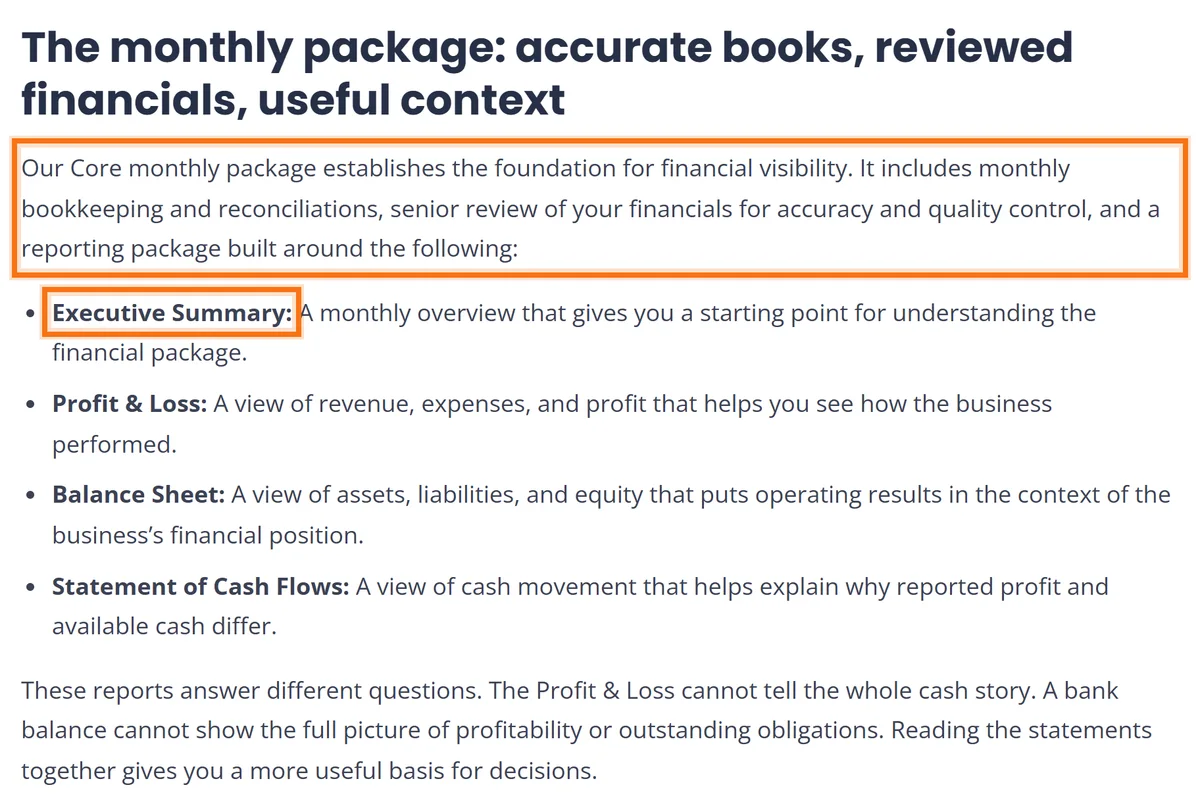
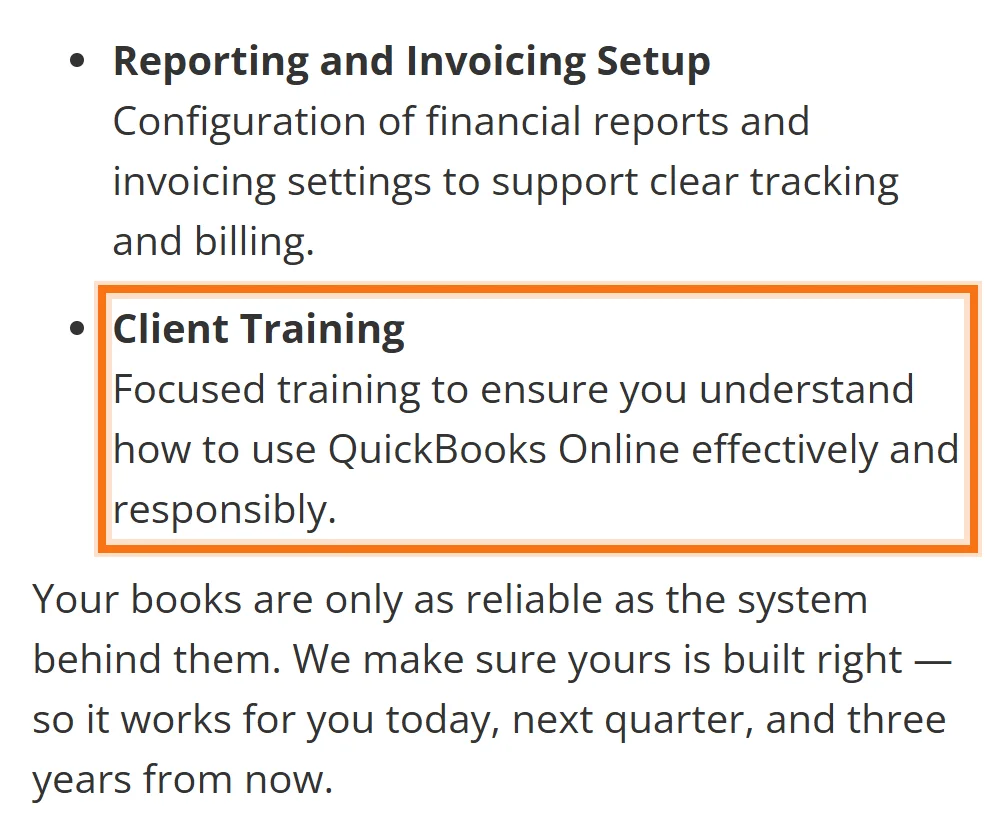
Every month’s package includes an Executive Summary on top of the Profit & Loss, Balance Sheet and Statement of Cash Flows, so the numbers come with an explanation. The Growth tier adds quarterly financial review meetings and the Scale tier monthly strategy meetings. Empowerment matters to us as well: when we set up QuickBooks Online, the last step is training the owner to use it effectively and responsibly. See our guide to the monthly reports your bookkeeper should send for what a complete package looks like.
Measuring client education in your own numbers
You do not need a survey to know whether client education works. Pick a few measures you can pull from your books and client records, and track them monthly:
- Client retention: how many clients from a year ago are still with you.
- Days to collect: the average time between invoice and payment, from your receivables aging.
- Revenue and margin per client: whether educated clients buy more and cost less to serve. Our article on project profitability for professional services shows how to measure it.
- Referral share: the share of new clients who came from an existing one.
- Repeat questions: a rough count of the questions your team answers more than once a month.
Challenges in client education and empowerment
- Time. Writing guides and FAQs takes hours up front. Start with the three questions you answer most and add from there.
- Too much detail. Clients want what affects their decisions, not everything you know. Lead with the point.
- Clients who do not want to learn. Some prefer to delegate entirely. Respect that, but still give them the summary and the access they need.
- Material goes stale. Prices, rules and processes change. Date your guides and review them at least once a year.
For the communication side of the same relationship, see our article on client communication and relationship management.
Frequently asked questions about client education
What is client education and empowerment?
Client education is teaching clients what they need to know to get the most from your service: how it works, what you need from them, and what your reports or results mean. Empowerment is giving them the access and confidence to make their own decisions with that knowledge.
Why does client education help a business grow?
Clients who understand what they bought ask fewer repeat questions, give you what you need on time, see the value in the work and are easier to keep and to ask for referrals. You can check whether it is working in your own numbers: retention, days to get paid and revenue per client.
What are the best ways to educate clients?
A clear written proposal, a structured onboarding, an FAQ built from real questions, plain-language summaries on every report, short training on any tool clients must use, and regular review meetings where you explain results and next steps.
How do I measure the return on client education?
Track a few numbers monthly from your books and client records: how many clients you keep year over year, average days to collect an invoice, revenue per client, the share of new clients who came by referral, and how much staff time goes to repeat questions.
How does LUCI Financial Solutions educate its clients?
LUCI publishes its process, pricing approach and answers to common questions on its site, includes a plain-language Executive Summary with the monthly statements, holds quarterly reviews on the Growth tier and monthly strategy meetings on the Scale tier, and trains owners when it sets up QuickBooks Online.
Numbers your business can act on
Reviewed monthly books, an Executive Summary in plain words and regular reviews. See our services and pricing.